A local citation is any place online that shows your business name, address, and phone number. It can be a directory listing, a map app, or a short mention in a news story. Citation building means you find those places, claim them, and keep the details the same everywhere. This guide shows which listings matter, the order to build them in, and how to keep them clean.
What is a local citation?
A local citation is a mention of your business on another website. It always shows your name, address, and phone number — your NAP. It often adds your website, hours, and category too. Google reads these mentions as proof that your business is real and sits where you say it sits.
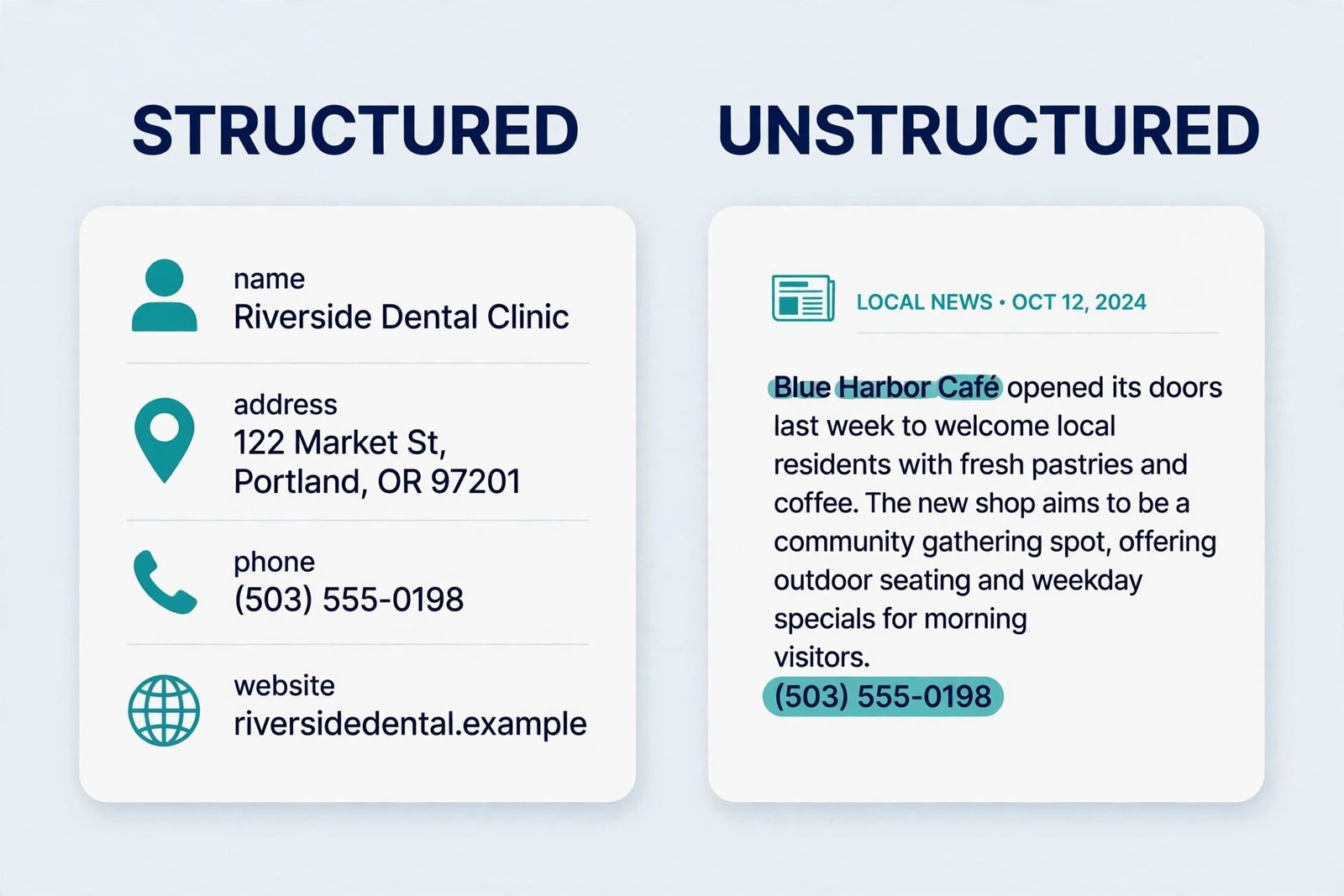
A structured citation sits in set fields on a directory page. Think of a Yelp listing, with a name box, an address box, and a phone box. An unstructured citation is a plain mention in running text. A local paper names your shop and prints your phone number in a story.
A good citation carries the same facts as your Google Business Profile. Name, address, and phone number must match. Your website link, hours, and category should match too. A citation with the wrong phone number does more harm than no citation at all. It sends customers to a dead line and tells Google two different stories about your business.
| Field | Needed | Good to add |
|---|---|---|
| Business name | Yes — your real name, no added keywords | — |
| Address | Yes — full street address, or hidden for service-area businesses | — |
| Phone number | Yes — your main number, the same everywhere | — |
| Website | Yes — link to your home page or location page | — |
| Category | Yes — the closest real match | — |
| Hours | Yes — keep them current | — |
| Description | No | Yes — one or two plain lines about what you do |
| Photos | No | Yes — your shop front, your team, your work |
| Services list | No | Yes — only services you really offer |
Do citations still matter in 2026?
Yes — but not in the way most guides claim. Citations are a small direct ranking factor for the Map Pack, and a much bigger one for AI search. Their real power is negative: wrong or mixed details hold you back, while clean details let your other work count.
Whitespark asked 47 local search experts to score 187 ranking factors for its 2026 survey. Citation signals carry about 6% of the local pack weight, 7% of local organic weight, and 13% of AI search visibility weight. The best single citation factor is consistency on the main search engines — Google Maps, Bing Maps, and Apple Maps. It ranks #28 of 187. The weakest is the sheer count of citations. It ranks #110. Read the full survey on Whitespark’s 2026 Local Search Ranking Factors page.
The trend runs down. Citations carried 12% of local pack weight in 2018. They carry 6% in 2026. Reviews and on-page signals took the ground they lost. But AI search is pulling citations back up. Three of the top five AI visibility factors are citation factors. Whitespark founder Darren Shaw puts it in one line: “In AI SEO, mentions (citations) are the new link.”
Google itself never names citations as a ranking factor. Google’s own guidance says local results rest on three things: relevance, distance, and prominence. Prominence rests on links and reviews. Citations feed prominence from the side. They confirm that your business exists, sits where you say, and trades under one name. That is why this guide treats citations as a base to build on, not as a lever to pull for a quick jump.
One more honest note. Citations will not fix a weak profile on their own. If your Google Business Profile is half empty and you have no reviews, fifty new listings will not save you. Our guide to ranking on Google Maps shows the full picture. Build your citations first because they are the base. Then work on reviews, categories, and links.
Which directories actually matter (and which to skip)
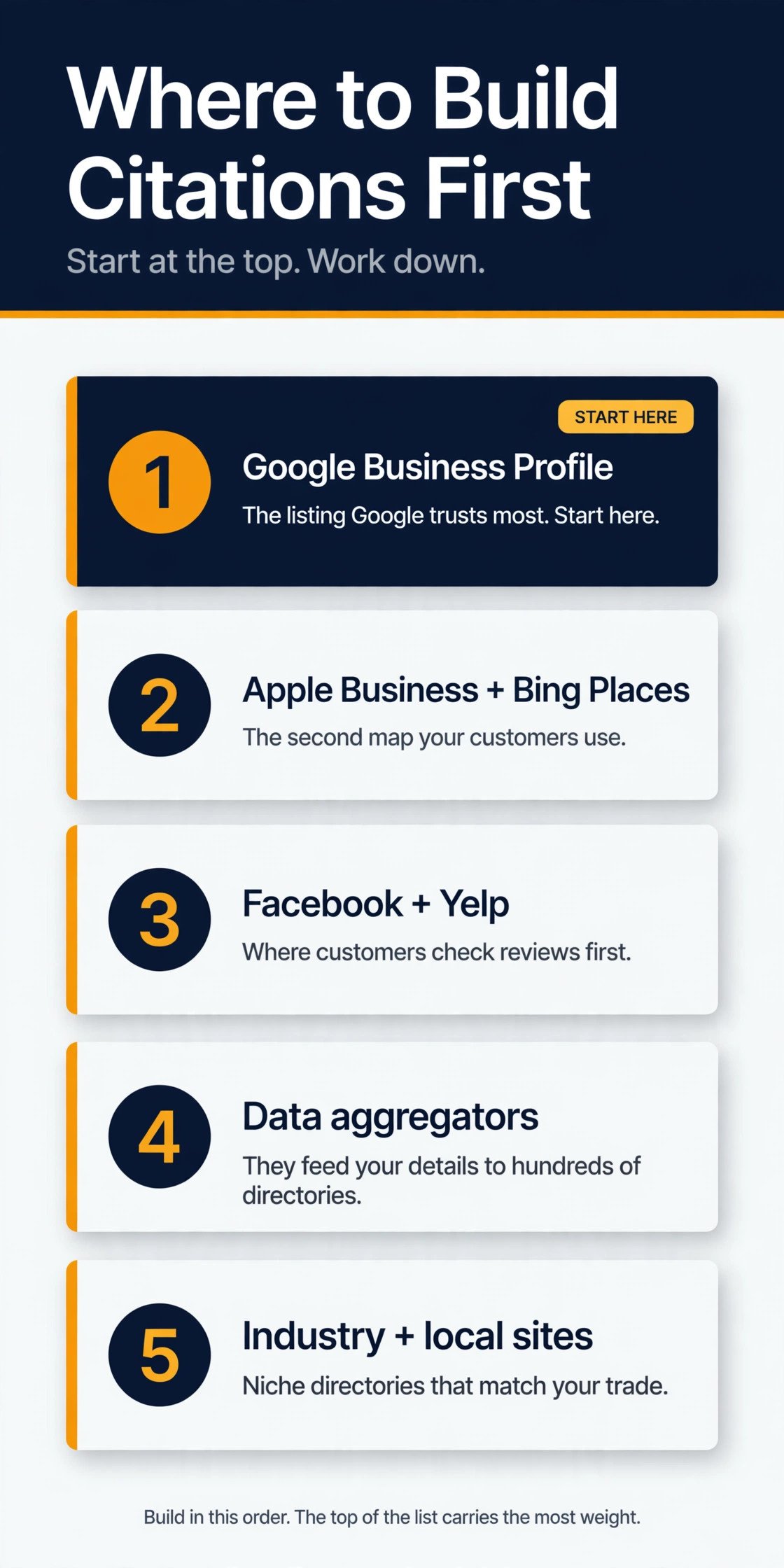
Start with a short core set. Most local businesses need 30 to 60 complete, correct citations — not 400 thin ones. The count is a rule of thumb, not a study. What matters is that each listing is complete, correct, and on a site your customers and Google both trust. Build in this order.
| Tier | Where | Why it matters |
|---|---|---|
| 1 — Claim first | Google Business Profile, Apple Business, Bing Places, Facebook, Yelp | These five feed Maps, search, and AI answers directly. Yelp alone shows up in 80% of ChatGPT local answers. |
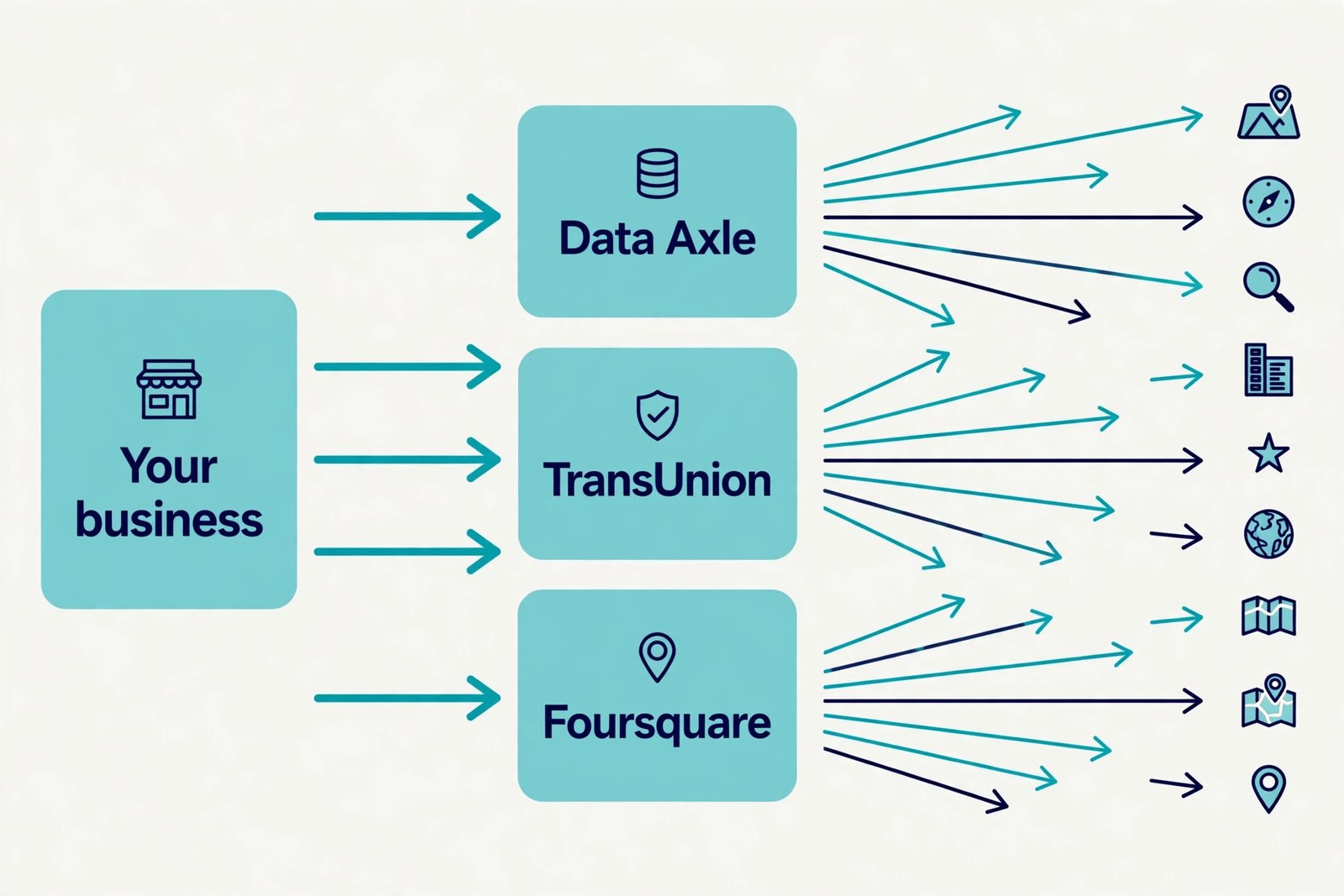
| 2 — Aggregators | Data Axle, TransUnion Digital Business Profile, Foursquare | They push your details out to dozens of smaller directories at once. Fix them once, and the fix spreads. |
| 3 — Your trade | Industry directories for your trade. For example, a builders’ register or a dental directory. | Trade sites prove what you do. |
| 4 — Your town | Chamber of commerce, town business list, local news business page | Local sites tie your business to your place. They also bring links, which feed prominence. |
| 5 — Skip | Paid link directories, $20 gig packages that promise hundreds of listings, general lists with no visitors | Thin listings add nothing. A bulk package can push wrong details to a hundred sites at once. |
Two names changed in 2026, and old guides still use the old ones. Apple Business Connect is now Apple Business. It launched on 14 April 2026, and your claimed spots moved over on their own. Neustar Localeze is now TransUnion Digital Business Profile. It launched on 23 April 2026. Use the new names when you claim or search for your listings.
Skip a directory if it fails a 60-second check. Search the directory for your city and your trade. If no real business shows up, skip it. If the listings have no reviews and no recent dates, skip it. If the site asks you for a link back before it lists you, skip it. A good directory lists you because you are a real business, not because you paid for a link.
Citations and AI search: what the data shows
AI answers cite listings far more than most owners expect. BrightLocal checked 1,355 business locations across Google AI Overviews, Google AI Mode, and ChatGPT in August 2026. It read 1,967,762 citations from 60,970 checks. Your Google Business Profile supplied 28.63% of all AI citations. Yelp supplied 9.53% overall and showed up in 80% of ChatGPT local answers. Facebook, TripAdvisor, OpenTable, MapQuest, and BBB followed. In total, the study cited 415 directories at least once. Read the study on BrightLocal’s AI directory sources page.
Three facts from that study change how you should build. First, outside the top few names, no directory reaches even 1% of AI citations. A long tail of tiny directories will not move your AI visibility. Second, about 93% of the domains AI cited were the businesses’ own websites. A listing supports your site. It never replaces it. Third, the directories that matter for AI are the same short list that matters for Maps. Build the core set first and stop at 30 to 60.
One more number to keep in mind. BrightLocal’s 2026 consumer survey found that 45% of people used AI tools for local recommendations in the past year, up from 6% the year before. The customers who ask ChatGPT for a plumber near them will see the businesses AI can verify. Clean citations are how AI verifies you.
The build order: 7 steps
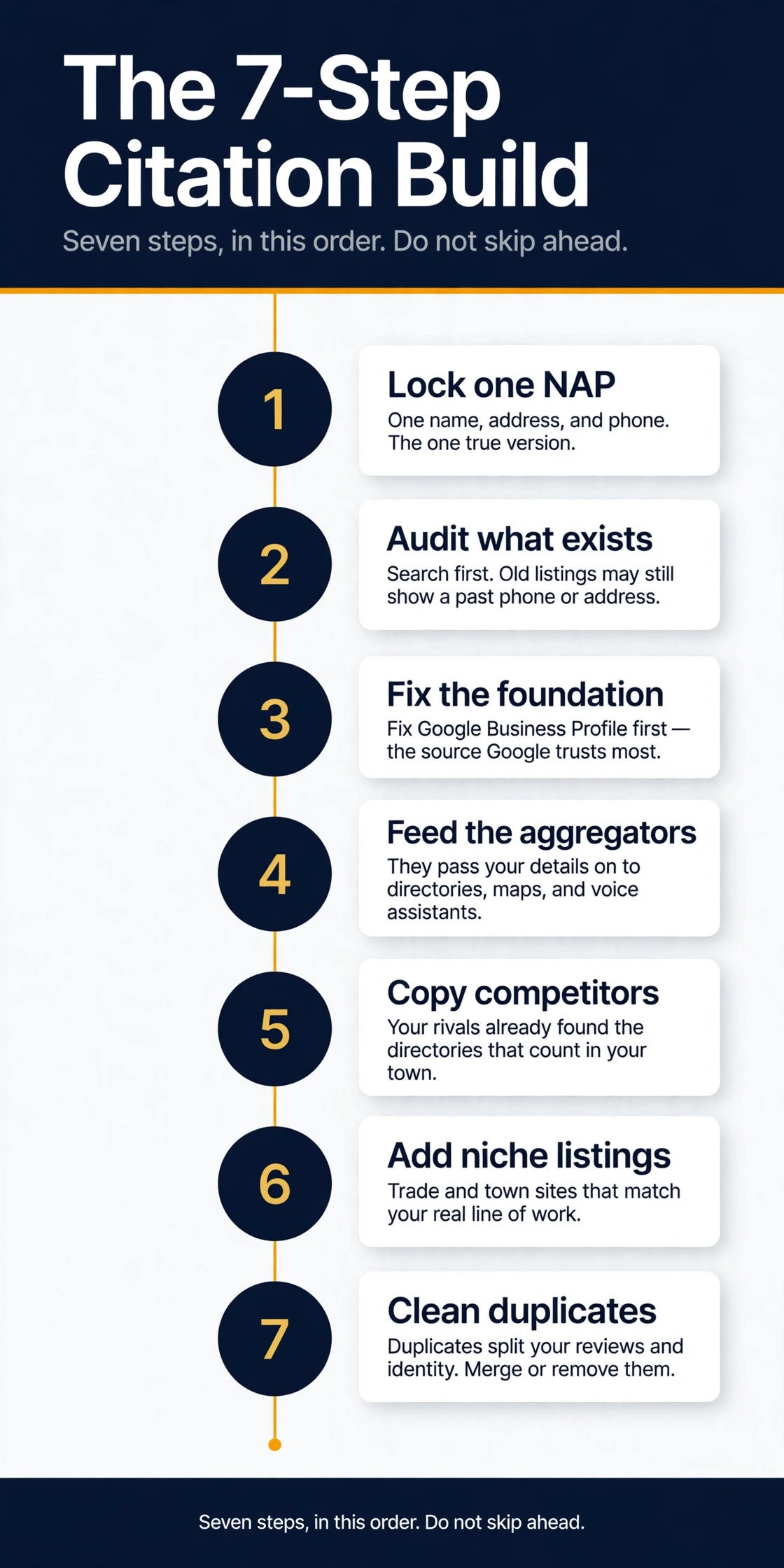
Work in this order. Each step feeds the next one. Finish step one before you jump to step five. You will push wrong details out to sites you then must fix one by one.
Step 1: Lock one canonical NAP
Pick one version of your name, address, and phone number. Write it down exactly as it appears on your shop sign and your website. This is your canonical NAP — the one true version. Every listing you build or fix must match it letter for letter.
Keep it in a simple sheet with three tabs. Tab one holds the master NAP: name, address, phone, website, hours, category, and a short description. Tab two tracks each listing: site name, listing URL, login, date built, and status. Tab three logs problems: duplicates, wrong details, and old addresses you still need to fix. Our NAP consistency guide shows how to pick the one version and what to do when your details have changed.
Step 2: Audit what already exists
Search for your business before you build anything. Old listings from years ago may still show a past phone number or address. Find them first, or your new work will sit next to wrong facts.
Run these four searches on Google, with quotes around each phrase. First, your business name plus your city. Second, your phone number in each format you have used. Third, your street address in quotes. Fourth, a site search on the big directories, like site:yelp.com “Your Business Name”. Note every listing you find in your tracker sheet. Mark each one as correct, wrong, duplicate, or old.
Step 3: Fix the foundation first
Fix your Google Business Profile before any other listing. It is the source Google trusts most. Match its name, address, phone, hours, and category to your canonical NAP. Then claim Apple Business, Bing Places, and Facebook, and check your own website footer and contact page. Our Google Business Profile guide walks through every field in order.
Add LocalBusiness schema to your website in the same pass. The schema must carry the same NAP as your profile. If the schema says one phone number and your profile says another, Google has to guess which one is right. Our LocalBusiness schema guide shows the fields that matter and a copy-paste example.
Step 4: Feed the data aggregators
Data aggregators collect business details and sell them on to directories, map apps, car navigation, and voice assistants. Three still run in 2026. Data Axle, once called InfoUSA, offers Local Listings free for one to ten listings, with free updates. TransUnion Digital Business Profile, once Neustar Localeze, pushes updates to more than 80 directories, maps, and apps. Foursquare sells location data covering more than 100 million places in 200 countries.
Submit your canonical NAP to all three. This is the one place where a single fix reaches far. When your aggregator data is right, new directories pick up the right facts on their own. When it is wrong, wrong facts spread to sites you have never heard of.
Watch out for dead names in old guides. Factual merged into Foursquare in April 2020. It no longer exists as a separate aggregator. Neustar Localeze became TransUnion Digital Business Profile in April 2026. Any guide that still lists Factual or Neustar Localeze as current is out of date. Do not follow its list.
Step 5: Copy your competitors’ citations
Your rivals already did the hard work of finding the directories that count in your town. Copy their list. Pick the top three businesses in the Map Pack for your main search. Search each one’s exact phone number in quotes on Google. Every directory that shows up for two or more of them goes on your build list. This takes about twenty minutes per rival by hand, and it finds the niche and local sites no generic list will give you.
Build only the listings that fit your business. A rival’s listing on a trade site you do not belong to will not help you. A rival’s listing on your town chamber site will. Check each one with the 60-second test from the tiers table above before you submit.
Step 6: Add industry and local citations
Now add the trade and town sites from tier three and four. A trade directory should match your real line of work. A dentist belongs on a dental directory. A roofer belongs on a roofing directory. A generic business list that takes anyone is worth less than one trade site that proves what you do.
Claim each listing with your own login, and save the login in your tracker sheet. Never let an agency keep the only login to your listings. If you part ways, you need to reach your own listings to fix them. Keep the description short and plain, and use the same one everywhere. Do not stuff keywords into your business name. Google calls that a guideline breach, and it can suspend your profile. Our guide to a suspended profile shows what happens next.
Step 7: Clean up duplicates and old data
Duplicates are the last step, not the first. A duplicate listing splits your reviews and your identity across two pages. Ask the directory to merge or remove the extra one. On Google, use the suggest-an-edit flow or the redressal form. On Yelp, ask support to merge the pages. On the aggregators, fix the source data first. If you fix a downstream directory but the aggregator still holds the wrong fact, the bad listing comes back within weeks.
Old data follows the same rule. Fix a past address or phone number at the aggregator first, then on the big directories, then on the small ones. Search your old address in quotes once a month for six months after a move. Stray listings with old details keep turning up for months.
Service-area businesses: citations with no public address
Many local businesses have no shop front. Plumbers, cleaners, and mobile services work from home or from a van. Their citations need a different setup. Hide your home address where the listing allows it, and set your service area instead. Never use a mailbox, a virtual office, or a shared work space address. Google treats that as a false address, and it can suspend your profile.
Your name and phone number still need to match everywhere. Your website should show your service area in plain words — the towns you serve — and your profile should list the same towns. A service-area business that lists a fake shop address will rank for a short while, then lose the profile when Google checks. The honest setup ranks slower and keeps ranking.
Multi-location businesses
Each site needs its own NAP. Give every location its own phone number, its own landing page on your website, and its own Google Business Profile. Never share one phone number across two locations. Google reads one number as one business, and your two sites will fight each other for the same searches.
Keep one master sheet per location, not one sheet for the whole brand. A fix for the Dallas shop must never touch the Tampa shop’s listings. Check each location on its own quarterly cycle, and keep the logins apart too. One shared login across ten locations is how one bad edit reaches all ten.
What citation building costs in 2026
You can build citations free if you have the time. You can also pay per listing or pay a service to do it once. I checked these prices on 23 November 2026. Prices change, so check the vendor page before you pay.
| Route | What it costs | Best for |
|---|---|---|
| Do it yourself | Free, plus your time (about 15–25 hours for the core set) | One site, a tight budget, and time to spare |
| BrightLocal Citation Builder | From $2 per citation, pay as you go, no monthly fee | Buying listings by hand, one at a time |
| Whitespark Listings Service | $20 to $999 one time per site, by package | A one-time cleanup plus build, with a report of every login |
| Data aggregators | Data Axle free for 1–10 listings; other feeds about $30 each | One fix reaching dozens of small directories |
| Managed local SEO | From about $499 a month per site | Many sites, or no time to do the work in house |
Read the prices on BrightLocal’s pricing page and the Whitespark Listings Service page before you order. A done-for-you package should hand you every login, every listing URL, and a report of what is live. If a service will not give you the logins, do not hire it. Those listings are yours, not theirs.
Pick the route that fits your case. A single site with an afternoon free should do it by hand. A business with ten wrong listings and no time should pay for a cleanup. A brand with five sites should use a tool that tracks them all in one place. There is no prize for paying when free works, and no saving in free work that never gets done.
How to keep citations clean over time
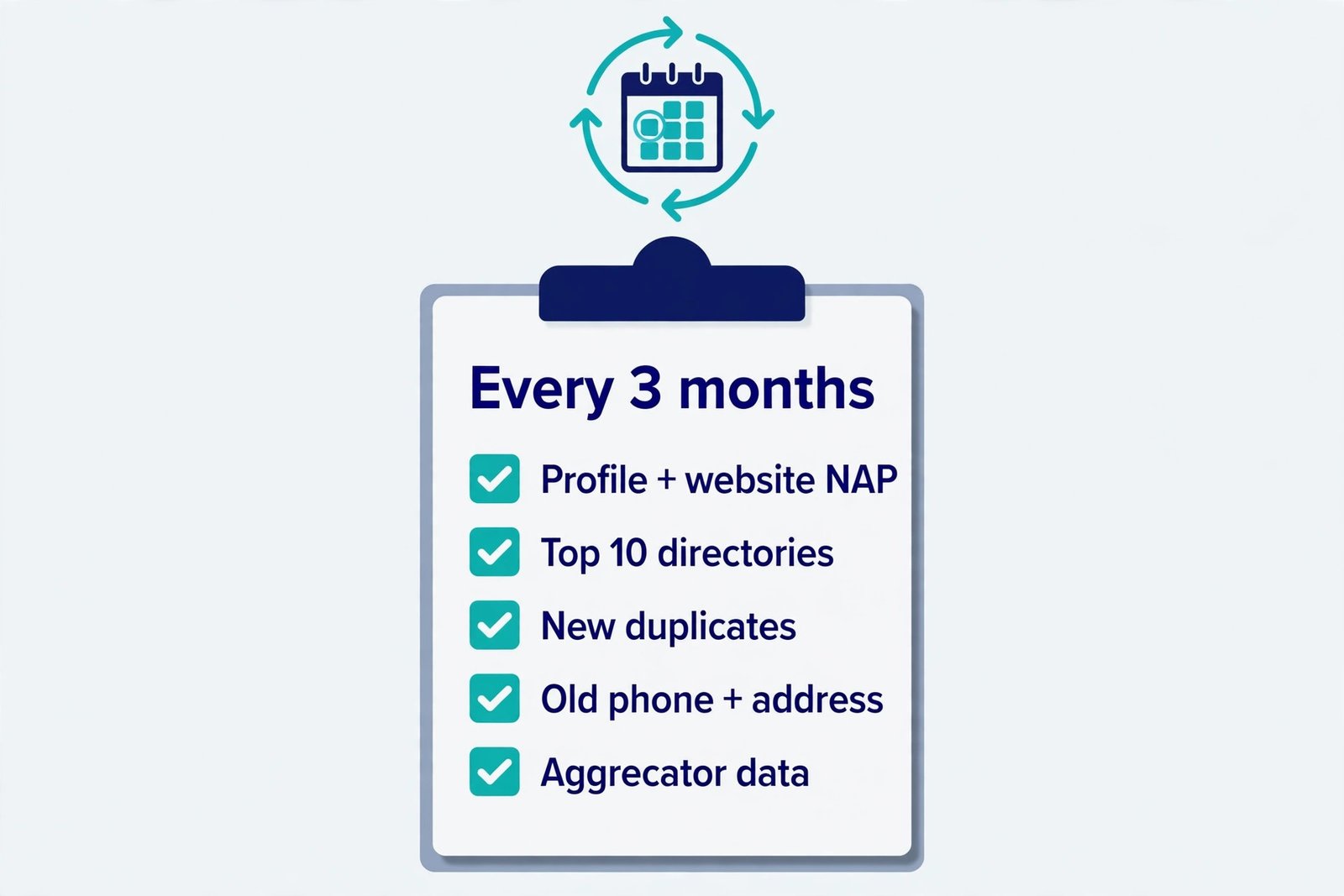
Citations rot. You change hours, move shop, or switch phones, and old facts stay live for years. One hour a quarter keeps the list clean. Run this check every three months, and run it again at once after any move, rebrand, phone change, or new site opening.
| Check | What to do |
|---|---|
| Your profile and website | Open your Google Business Profile and your website footer. Both must show the canonical NAP. |
| Your top ten directories | Open your ten biggest listings. Fix any wrong name, address, phone, hours, or category. |
| New duplicates | Search your name plus your city. Merge or remove any new duplicate listing. |
| Old details | Search your old phone number and old address in quotes. Fix any listing that still shows them. |
| Aggregator data | Check your three aggregator feeds. Fix wrong facts at the source before you fix the small sites. |
| Hours and holidays | Update holiday hours on your profile and your top listings before the season starts. |
| Tracker sheet | Log every fix with a date. A fix with no record gets lost the next time someone changes a detail. |
Mistakes that cost you rankings
Most citation damage comes from a short list of errors. Check your work against each one before you call the job done.
Chasing count over quality is the first error. A listing with no photo, no hours, and a bare name adds nothing. A bulk order can spread one wrong phone number to a hundred sites. Second, leaving duplicates live splits your reviews and your identity. Merge them. Third, using a call tracking number on your profile and your directories breaks your NAP. Keep tracking numbers on your own website and ads only, and keep your real number on every public listing. Our NAP guide shows the setup that keeps tracking without breaking your NAP.
Fourth, trusting a stale list. Some guides still name Factual as an aggregator, still call TransUnion by its old name, and still list B2B contact databases as aggregators. A contact database is not a citation source. Follow the current names in this guide, not a list from 2020. Fifth, paying for links. A directory that asks for a paid link before it lists you is selling links, not listings. Skip it. Sixth, letting someone else hold your logins. Your listings are business assets. Keep every login in your own tracker sheet.
How long until citations help?
Set honest hopes. Aggregator changes take four to twelve weeks to flow out to the small directories. A new listing may take days to show up, or weeks. Ranking movement from citations takes weeks to a couple of months, and it comes mixed in with your reviews, your profile, and your links. No one can split out the citation share of a ranking change.
Judge the work after one full quarter. Check your Map Pack position on a rank grid before you start and again after three months. Our local SEO checklist puts citations in their place: one step in a 30-step order, not the whole job. If your citations are clean and your reviews are growing, you have done the base work right. The rest is patience and steady effort.
The ones that do it right get a clean base under everything else. Google trusts their profile, AI can verify their listings, and customers reach the right number on the first call. Start with step one today. Lock your canonical NAP, run the audit, and build the core set in order. If you want help with the full job.
We will check your citations, your profile, and your rankings together.
FAQ
What is a local citation?
A local citation is any place online that shows your business name, address, and phone number. It can be a directory listing, a map app, or a mention in a news story. Google reads these mentions as proof that your business is real and sits where you say it sits.
How many citations do I need?
Most local businesses need 30 to 60 complete, correct citations. The count is a rule of thumb, not a study. A complete listing on a trusted site counts more than ten thin listings on sites no one visits. Stop at the core set, then spend your effort on reviews and your website.
Do citations help Google Maps rankings?
They help a little, and they help AI search more. Whitespark’s 2026 survey puts citation signals at about 6% of local pack weight and 13% of AI search visibility weight. Their main job is to confirm your identity. Wrong citations hold you back more than right ones push you up.
What is a data aggregator?
A data aggregator is a company that collects business details and sells them on to directories, map apps, and voice assistants. The three that still run in 2026 are Data Axle, TransUnion Digital Business Profile, and Foursquare. Fix your facts there first, and the fix spreads to dozens of small sites.
Should I pay for citation building?
Pay if you lack the time, not because paid listings rank better. BrightLocal builds citations from $2 each, and Whitespark sells one-time packages from $20 to $999. A free build by hand works just as well if you follow the order in this guide. Prices checked 23 November 2026.
How do I remove a wrong listing?
Claim the listing first, then fix it or ask for removal. On Google, use the suggest-an-edit flow or the redressal form. On Yelp, ask support to merge duplicates. Fix the wrong fact at the data aggregator first, or the bad listing will come back within weeks.
Do I need citations if I have a Google Business Profile?
Yes. Your profile is the main listing, but it is not the only one. Directories, map apps, and AI answers all check other sources to confirm your facts. A business with one listing and no other trace looks thin to Google and to AI. Build the core set, keep it clean, and let it back up your profile.